


Why your designer bags are more vulnerable to mould than you think
by Kath P on May 28, 2026
You spent thousands on that bag. You keep it in its dust bag, on a shelf, away from sunlight. You've done everything the care guides say. And then one season you take it out and find a faint white bloom across the leather — and that particular dread sets in.
Mould on designer bags is one of the most common and most heartbreaking things that happens to a collection. The good news is it's almost entirely preventable. The bad news is the cause isn't the bag — it's the air around it.
What makes leather a mould target
Leather is an organic material. Even after tanning and finishing, it retains trace moisture and organic compounds — the tannins, oils and conditioning agents that keep it supple. Mould spores, which are present in every home at all times, need only two things to activate: moisture and an organic food source. Leather provides both.
Research confirms that mould growth on leather is driven by environmental factors — moisture, warmth and limited airflow — combined with the organic composition of the material itself. The fungi don't discriminate between a $50 handbag and a $15,000 Birkin. Both offer what mould needs to grow.
The humidity threshold that matters
Multiple studies land on the same number: relative humidity above 70% significantly facilitates the growth of mould and mildew on leather. Research by Liao, Zhao and colleagues confirms that maintaining relative humidity between 50–55% is critical for preventing fungal contamination and preserving leather integrity.
In Australian homes — particularly in coastal cities, during humid summers, or in bedrooms and wardrobes without adequate ventilation — humidity regularly climbs above that threshold. The wardrobe you store your bags in is not a neutral space. It's an enclosed microclimate, and in humid conditions it becomes warmer and more stagnant than the rest of the room.
What mould actually does to your bags
The visible signs — white or grey blooms, dark spotting, a musty odour — are only the start. Once mould establishes itself on leather it begins feeding on the organic compounds in the material. Spores penetrate the surface, causing discolouration, weakening of fibres and structural breakdown. On Chanel's signature lambskin the damage is especially rapid because the leather is so fine. On Hermes Togo or Clemence, the pebbled texture creates micro-pockets where spores lodge and multiply out of sight.
From a resale and investment perspective, the financial impact is real. Even minor mould signs can reduce a bag's resale value by 20–50% or more. A Hermes Birkin in pristine condition commands a dramatically different price than the same bag with mould staining — even if professionally treated.
Inside the wardrobe: where the problem starts
Most designer bag mould happens not during use but during storage. A bag carried on a humid day absorbs moisture from the air. Returned to its dust bag without drying out, placed in an enclosed wardrobe, it sits in exactly the conditions mould needs: trapped moisture, organic material, warmth, darkness. The dust bag meant to protect it can accelerate the problem if the bag inside wasn't fully dry when it went in.
Luxury house care instructions assume a temperate climate with seasonal variation. In Australian homes, those conditions require active management — not just passive storage.
What actually works
Store bags in breathable fabric dust bags, never plastic. Ensure airflow in the storage space. Use silica gel packets and replace them monthly. Check your collection every four to six weeks, not just at the change of season. But most importantly: control the ambient humidity in the room and wardrobe where your bags live. Everything else is management after the fact. Humidity control is prevention at the source.
The investment case for humidity control
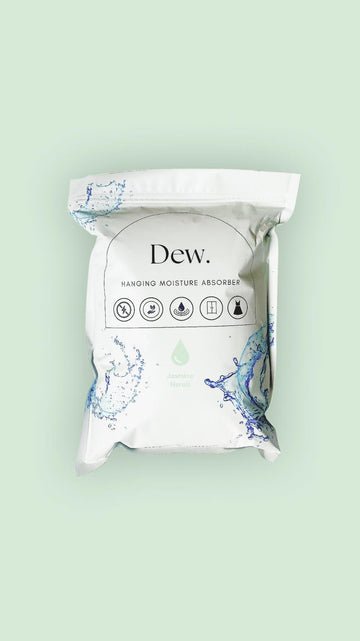
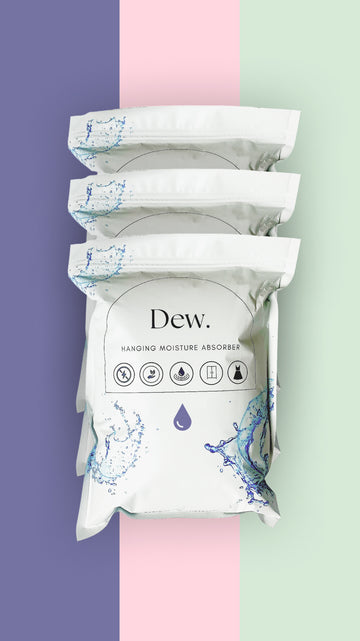
A single mould episode on a designer bag can cost thousands in restoration — or reduce its resale value by up to 50%. A Dew Moisture dehumidifier holding your bedroom and wardrobe at 50–55% relative humidity costs less than a professional cleaning appointment. Browse our range.


