


The Ocean Smell and Its Benefits: Why Salt Air Makes Us Feel Good
by The Dew Team on Jun 30, 2026
The smell of the ocean has measurable effects on stress, mood, and cognition. The fresh, salt-air quality comes from compounds like dimethyl sulfide produced by marine phytoplankton, combined with negative ions in sea spray. Research consistently links exposure to coastal environments — including the scent of them — with reduced stress, improved sleep, and a state psychologists call "blue mind."
What "ocean smell" is actually made of
That distinctive seaside scent isn't a single thing — it's a complex mix of natural compounds that, together, signal "ocean" to the brain:
- Dimethyl sulfide (DMS): Produced by marine phytoplankton, this is the primary source of the classic salty-fresh ocean smell. Counterintuitively, it's a sulphur compound — but at sea-air concentrations, it reads as fresh and clean
- Bromophenols: Released from seaweed and marine vegetation, these contribute a slightly briny, mineral note
- Negative ions: Generated by crashing waves, these aren't smelled but contribute to the feeling of "fresh air"
- Ozone (in trace amounts): Produced by UV and wave action, ozone adds a slightly sharp, electric quality
- Salt aerosols: Fine particles of seawater carried in the air
Interestingly, the ocean doesn't actually have a strong smell out in deep water — most of what we associate with the "smell of the sea" is created at the shoreline where waves, marine life, and air interact.
The wellbeing benefits of ocean scent
Stress and cortisol reduction
Research from the University of Exeter and others has documented that exposure to coastal environments measurably reduces cortisol (the stress hormone), blood pressure, and self-reported anxiety. Some of this is visual and auditory, but olfactory cues are a significant part — we associate ocean smells with relaxation and the brain responds before we consciously process the environment.
The "blue mind" effect
Marine biologist Wallace J. Nichols coined the term "blue mind" to describe the mildly meditative state induced by proximity to water. The smell of the ocean is one of the triggers — even when reproduced indoors, it can prompt some of the same relaxation response.
Better sleep
Coastal residents consistently report better sleep quality than people in inland urban environments. While many factors contribute, the salt air and the associations it carries are part of the picture. Studies on "environmental fragrance" in bedrooms suggest ocean-style scents perform well alongside lavender and jasmine for sleep quality.
Improved breathing
The negative ions and salt aerosols in coastal air have been linked to improved respiratory function in some studies, particularly for people with asthma or allergic conditions. Indoor ocean-style scents don't replicate the negative ions, but the smell itself can trigger deeper, calmer breathing through psychological association.
Mood and creativity
Several studies have linked coastal exposure to higher reported mood, greater creativity in problem-solving tasks, and increased feelings of freedom. The smell is one of the cues the brain uses to trigger these states.
Why coastal Australians get attached to the smell
If you've grown up near the ocean — Sydney, Brisbane, Perth, the Gold Coast, anywhere along the Australian coast — the smell of salt air is wired into your sense of home. There's good neuroscience behind this. Olfactory memories form in the same brain region (the limbic system) that handles emotion. That's why a familiar smell can produce a sudden emotional response that feels disproportionate — it's directly tied to memory and feeling.
This is why ocean-scented products do particularly well in Australian homes — they tap into something deeply familiar.
Bringing ocean scent into your home
In coastal homes
If you live near the ocean, you might wonder why you'd want the scent indoors when you've got the real thing outside. The answer: humidity. Coastal humidity means salt air can also bring moisture problems into wardrobes and storage. A moisture absorber with an ocean scent gives you the wellbeing cue alongside the practical humidity control — the smell of the sea without the damp that comes with it.
In inland homes
For people in inland cities or homes that don't get coastal breezes, ocean-scented products bring a small piece of that wellbeing benefit indoors. Bathrooms, ensuites, and bedrooms are natural places to use them.
In holiday homes and Airbnbs
For coastal rentals, ocean scent reinforces the sense of place and creates a positive guest experience from the moment they walk in. A moisture absorber doubles as practical protection for holiday homes that sit empty between bookings — our guide on caravan and boat moisture covers the long-empty-space scenario in detail.
Combining scent with humidity control
Coastal areas of Australia have some of the country's highest humidity. Sydney averages 70%; coastal Queensland higher still. The same conditions that produce that lovely salt air outside create real wardrobe and storage problems inside — our piece on stopping mould in humid Australian homes covers what to do about it.
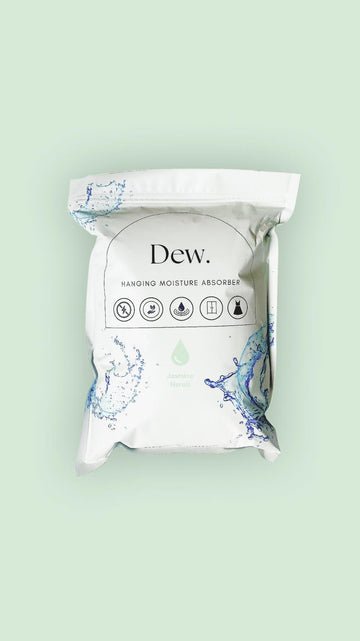
A scented Dew. Moisture Absorber with an ocean fragrance is a way to embrace the coastal lifestyle without the downsides. You get the daily mood lift of the scent and the humidity reduction that protects your clothes, leather, and stored items — working continuously for 45–90 days at a time.
Frequently asked questions
Why does the ocean smell like that?
The classic ocean smell comes mostly from dimethyl sulfide produced by marine phytoplankton, combined with bromophenols from seaweed, traces of ozone, and salt aerosols carried in the air. Most of what we smell as "ocean" is generated at the shoreline rather than out at sea.
Are ocean scents really relaxing?
Yes — both psychologically (through memory and association) and physiologically (research links coastal scents to measurable reductions in stress markers). The effect is part "blue mind" psychology and part genuine olfactory response.
Can ocean-scented products help with sleep?
For people who associate the ocean with relaxation, yes. The same scent might not work for someone with no positive associations — olfactory memory is personal. For coastal Australians, ocean scents tend to be particularly effective sleep cues.
Is the salt in ocean air bad for clothes?
Yes. Salt-laden coastal humidity accelerates corrosion on metal hardware (zips, buckles), can cause discolouration on fabric over time, and contributes to general humidity-related damage. Controlling indoor humidity with a moisture absorber helps significantly.
The smell of the ocean is more than nostalgia. It's a measurable wellbeing cue, and one Australians are particularly tuned into. Bringing it indoors — alongside the humidity control that coastal living actually needs — is one of those small home upgrades that pays off every day.


